Argentine ants (Linepithema humile) present unique challenges across the Inland Empire because multiple queens coexist across sprawling, interconnected supercolonies. When summer temperatures climb over 100 degrees…
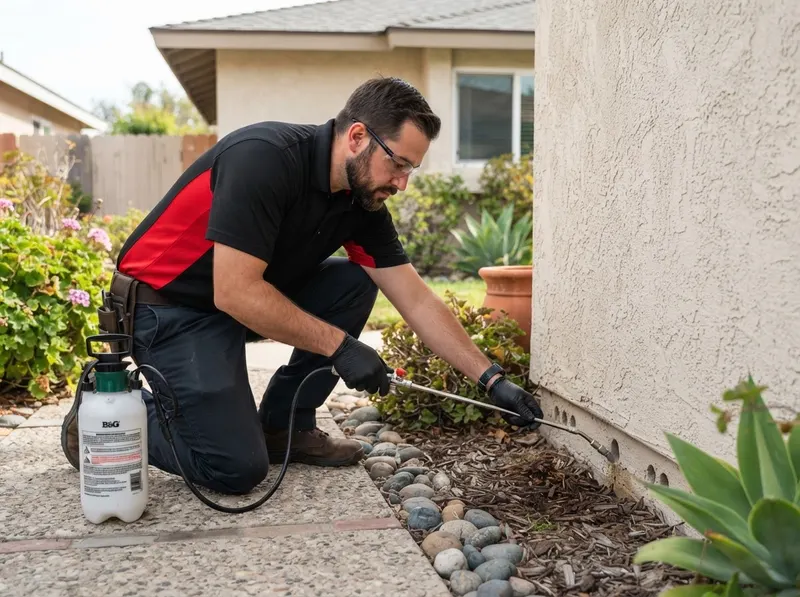
Argentine ants (Linepithema humile) present unique challenges across the Inland Empire because multiple queens coexist across sprawling, interconnected supercolonies. When summer temperatures climb over 100 degrees Fahrenheit or winter rains saturate native soil near California Citrus State Historic Park, entire colonies abandon drying yard cover and move directly against concrete stem walls. Standard over-the-counter pyrethroid sprays repel foraging worker ants without impacting subterranean queens, causing colonies to splinter through budding into multiple auxiliary nests inside wall voids. Effective containment requires an undetectable non-repellent liquid barrier applied along the immediate building envelope, allowing foragers to track active transfer agents directly into central brood chambers according to UC IPM pest notes on Argentine ants.
Neighborhoods with older architectural framing and dense citrus plantings, such as the Wood Streets and Victoria Woods, experience high trail activity along exterior foundation weep screeds. Newer slab constructions throughout Orangecrest and Canyon Crest face invasions along seismic expansion joints and subterranean drip irrigation manifolds. The California Department of Pesticide Regulation establishes strict surface application protocols to safeguard urban watersheds, restricting liquid barrier applications around concrete walkways and drains. Applying targeted liquid applications to the lower 12 to 24 inches of exterior vertical masonry while injecting slow-acting baits into turf margins near Fairmount Park preserves environmental controls without sacrificing interior containment.
1. Technical foundation inspection: Technicians survey the full linear perimeter, marking moisture leaks, plant bridges touching stucco, and active pheromone trails originating near utility penetrations. 2. Exterior barrier application: Operators apply an EPA-registered non-repellent formulation compliant with EPA pesticide standards up to two feet up the foundation wall and one foot outward on bordering soil. 3. Moist zone bait deployment: Technicians install enclosed, child-resistant bait stations along drip irrigation boxes and subterranean piping where colony queens source water, in alignment with recommendations from the National Pest Management Association. 4. Moisture and landscaping clearance: Technicians identify landscape contact zones and coordinate with homeowners to maintain a 12-inch clear air-gap between vegetation and exterior masonry, mitigating reinvasion risks documented by UCR Department of Entomology research. Homeowners needing immediate structural assessment can call (951) 709-8191.
Every job gets a firm, written price after a free on-site visit.
For standards, safe disposal, and service guidance on pest control services in Riverside, CA, useful references include U.S. EPA, ENERGY STAR, U.S. Dept. of Energy, Consumer.gov, U.S. Census Bureau, and Google Maps. General consumer and small-business resources are available from USA.gov, Better Business Bureau, FTC Consumer Advice, U.S. Small Business Administration, and Ready.gov.
Tell us about your argentine ant perimeter control job in Riverside and we'll send a clear, written quote, usually the same day.
 Junction Pest Experts